
The Difference Between Having the Title and Being the Leader
Every leader I’ve worked with in the past thirty years has faced the same quiet crisis, usually within the first year of a promotion. They were brilliant at their old job. That’s exactly why they were promoted. And then, without anyone telling them, the very thing that made them brilliant started working against them.
It isn’t a discipline problem. It isn’t a time management problem. It’s what happens when your job changes completely, but your identity as a leader doesn’t.
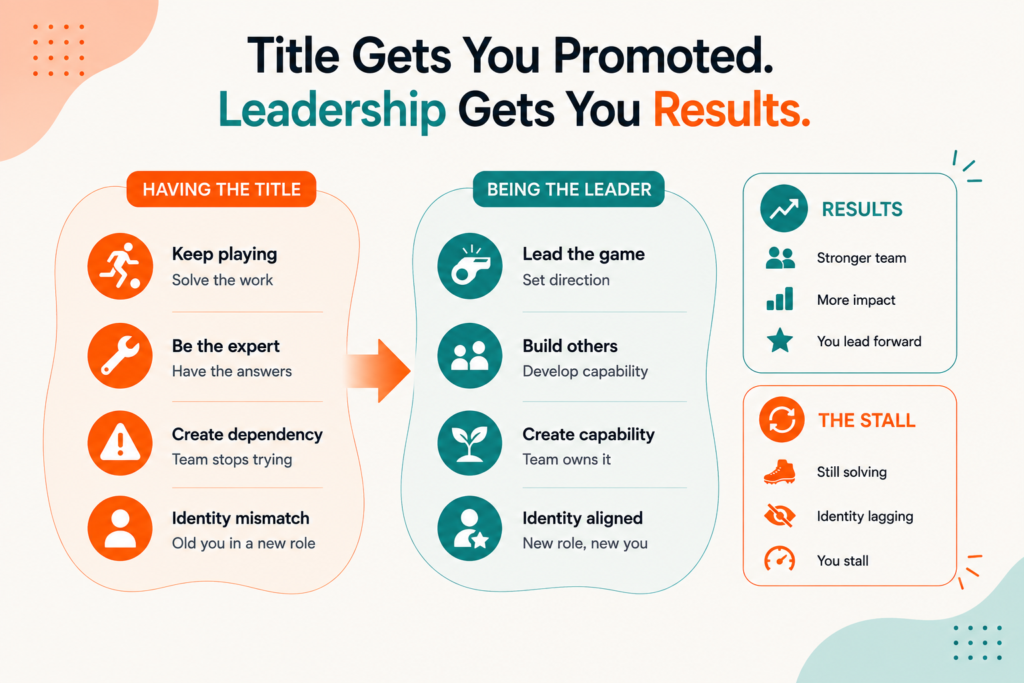
Think about a football team for a moment. The best player on the field — the one who reads the game better than anyone, gets pulled off and handed a whistle. Nobody expects that player to keep playing. Everyone understands the job has changed entirely. Their role now is to make everyone else better, not to keep scoring themselves.
That’s not what happens to most new leaders.
They get promoted, and they’re still expected – by their organisation, and usually by themselves, to keep playing. Keep solving. Keep being the one with the answer. Nobody hands them a whistle. They just quietly keep wearing the boots.
I worked with a leader a while back who was sharp and technically excellent, recently promoted to run a team she’d been part of for years. Six months in, she was still the one fixing every error before it went out the door. Her team had stopped even trying to catch their own mistakes, because they knew she would anyway. She wasn’t a bad leader. She was doing exactly what had made her successful for the ten years before her promotion.
That’s the trap. The way you see yourself as a leader gets built in your very first leadership role, usually a frontline one, where you were promoted because you were the best technical performer on the team. In that role, being a good leader looked like being the expert, having the answer, catching the mistake before anyone else could. Nobody told you that was wrong – it worked, and people called you a good leader because of it.
The problem is that version of “good leader” doesn’t update itself when your responsibilities change.
It sits underneath, running quietly, shaping what you do without you ever deciding it on purpose. So you keep playing. You keep solving problems that aren’t yours to solve anymore. You keep being the expert in a role that actually needs you to build experts, not be one.
That’s the stall. It’s not a skills problem. It’s not a confidence problem. It’s an identity that hasn’t caught up with the role.
This week, notice how often you’re the one solving the problem instead of asking the question that helps someone else solve it. That single pattern will tell you more about where you’re stuck than almost any amount of leadership advice.
If this resonates
The Leader’s Identity Blueprint will show you exactly why this happens and where it’s showing up in your own leadership.
 Or call Ross directly on 0412 490 250
Call Team Focus Plus on 1300 551 274 or Email team@teamfocusplus.com
Stay Connected
Sign up for our newsletter to get updates on upcoming workshops and transformational leadership programs.