
The technical expert trap
Someone knocks on your door, or catches you in the hallway.
“Quick question.”
It’s never actually quick. But you answer it anyway, because that’s what you do. You’re the one with the answers. You always have been. That’s not a compliment anymore. It’s the thing keeping you stuck.
Why being needed feels like leading — and isn’t
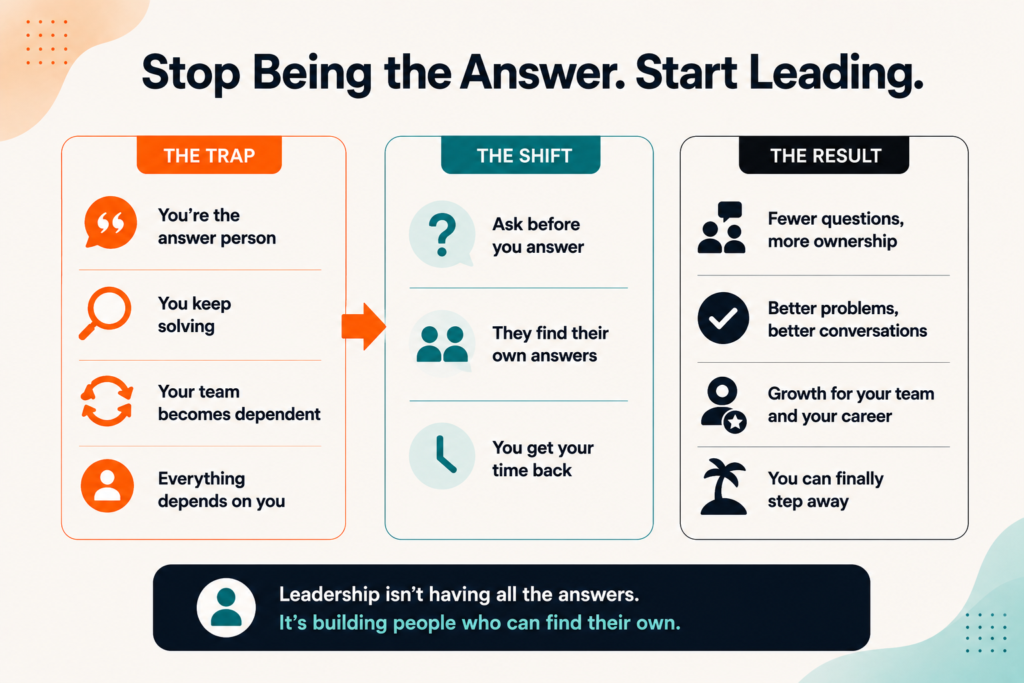
Here’s the trap. Being the answer person feels like leadership. You’re helpful. You’re across everything. People trust you enough to ask. But notice what’s actually happening every time you answer instead of asking back. You’re solving the problem. They’re not.
Do that enough times, and you’ve trained your entire team to bring you their thinking instead of doing it themselves. Not because they can’t. Because you made it easier not to.
That’s the Technical Expert Trap in its most exhausting form. You got promoted because you had the answers. Now the role needs something else from you, and nobody told you the thing that made you valuable is the thing now holding you back.
What it’s actually costing you
Add it up. Every “quick question” is five minutes. Multiply that by a team of eight, ten, fifteen people, every single day.That’s not five minutes. That’s your entire capacity to actually lead, spent being everyone’s search engine instead.
And here’s the part that stings: it’s not making your team better. It’s making them more dependent. The more available you are with answers, the less reason anyone has to develop their own.
You end up with a team that can’t function without you in the room — which means you can never actually step back, get promoted again, or take a real holiday without everything quietly stalling.
The two questions that change it
You don’t fix this by becoming less available. You fix it by changing what you do when someone asks. Next time someone brings you a problem, try this instead of the answer:
“What did you do well so far?”
“What would you do differently next time?”
That’s it. Two questions. Ask them before you offer anything. Notice what happens. Most of the time, they already know the answer. They just wanted permission to say it out loud, or backup in case they were wrong. You didn’t need to solve it. You needed to ask.
The times they genuinely don’t know — that’s when you offer what you think, after you’ve asked. Not before.
What if you actually did this, every time?
Picture a week where you asked before you answered. Every time.
Your team starts bringing you fewer questions, not because you’re less approachable — because they’ve started trusting their own thinking. The ones they do bring you are the ones that actually need you. You get time back. Real time. Not because you’re doing less leading — because you’re finally doing the leading part, instead of the fixing part.
That’s the shift. Not becoming less useful. Becoming useful in a completely different way.
Where to start
You don’t need a training course to try this. Ask the two questions tomorrow, on the next thing that lands on your desk. See what happens.
If it works — and it will, more often than you expect — the harder part isn’t the technique. It’s building it into a habit instead of a one-off. That’s exactly what Leadership Foundations is built to help with: not more theory, a structured way to actually make this your default instead of your exception.
So — next time someone says “quick question,” what will you do differently?
Start Leadership Foundations
 Or call Ross directly on 0412 490 250
Call Team Focus Plus on 1300 551 274 or Email team@teamfocusplus.com
Stay Connected
Sign up for our newsletter to get updates on upcoming workshops and transformational leadership programs.