
Some leaders can run every meeting well, hit every target, say all the right things in a one-on-one and still not actually feel like a leader. Not to their team. Not even to themselves. None of that shows up on a performance review, because on paper, everything is right.
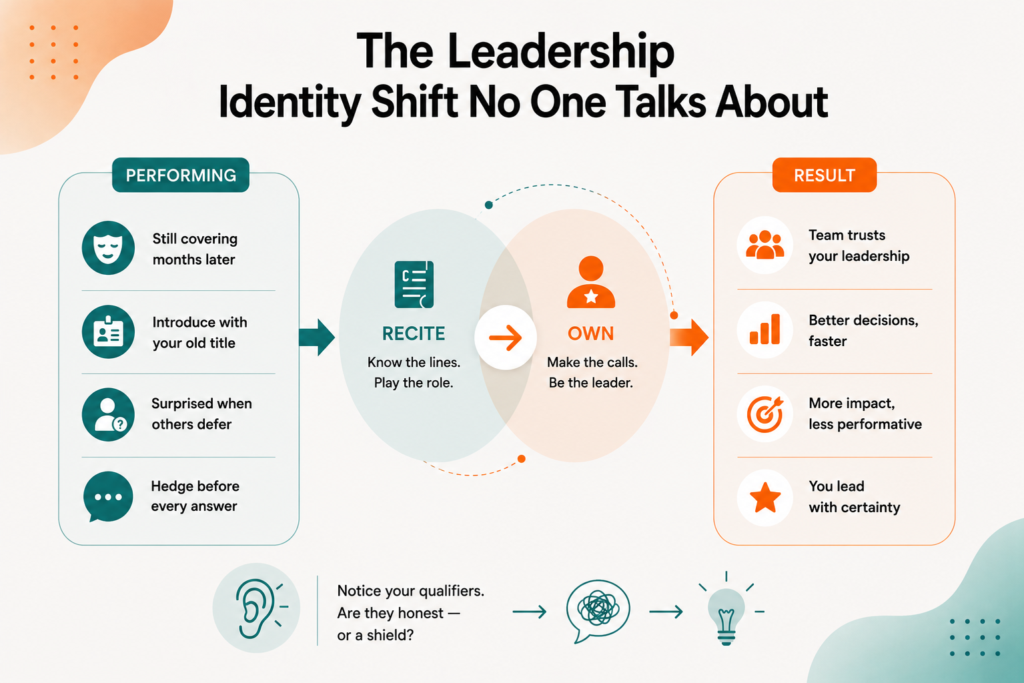
It shows up in smaller ways instead. You catch yourself saying “I’m just covering this for now,” months after “for now” should have ended. You introduce yourself with your old job title out of habit. You feel a flicker of surprise every time someone defers to your decision, as though they’ve made some kind of mistake trusting you with it.
Think of an actor cast in a lead role. In early rehearsals, they know every line, hit every mark, say every word at the right moment. And yet something is missing — the performance is technically correct and somehow still hollow, because the actor is performing the character rather than being them. The shift that happens later in rehearsal isn’t about learning more lines. It’s a point where the actor stops reciting the character’s decisions and starts making them, as though the choice is genuinely theirs.
Leadership works the same way.
You can learn every line of the role — the meeting structures, the delegation, the feedback frameworks — and still be reciting them, performing a version of leadership you’ve studied rather than one you’ve actually stepped into. You can do that convincingly enough that nobody around you notices. Sometimes you don’t notice yourself, not until something forces the gap into view.
I worked with a leader eight months into a promotion, running a solid, well-regarded team. Every time someone asked him a direct leadership question, he had a habit of saying, “well, I’m still finding my feet, but I think…” His team had started to expect it, a small verbal shrug before every opinion.
He genuinely thought it was just humility.
Then, in an ordinary team meeting, a junior team member asked him a straightforward question and simply waited for the answer, pen ready, no hesitation in the question at all. He answered without his usual hedge, purely on reflex. Afterwards, he told me it was the first time in eight months he’d actually sounded like the person his title said he was, rather than someone auditioning for it.
Nothing about his skills changed that day. He’d known the answer for months. What changed was that, for one unguarded moment, he stopped performing the decision and simply made it.
This week, listen for the small qualifiers you add before an opinion or decision that’s genuinely yours to make. Not because confidence should replace honesty, but because it’s worth noticing how often that hedge is protecting you from owning the decision, rather than protecting anyone else from anything.
If this resonates,
The Leader’s Identity Blueprint will help you understand exactly why this gap opens up and what closes it.
 Or call Ross directly on 0412 490 250
Call Team Focus Plus on 1300 551 274 or Email team@teamfocusplus.com
Stay Connected
Sign up for our newsletter to get updates on upcoming workshops and transformational leadership programs.