Leadership is one of the most talked-about topics in business, and one of the most misunderstood.
Despite decades of research, programs, and commentary, many leaders are still operating from outdated assumptions about what leadership is and how it works. Those assumptions quietly undermine performance, engagement, and succession.
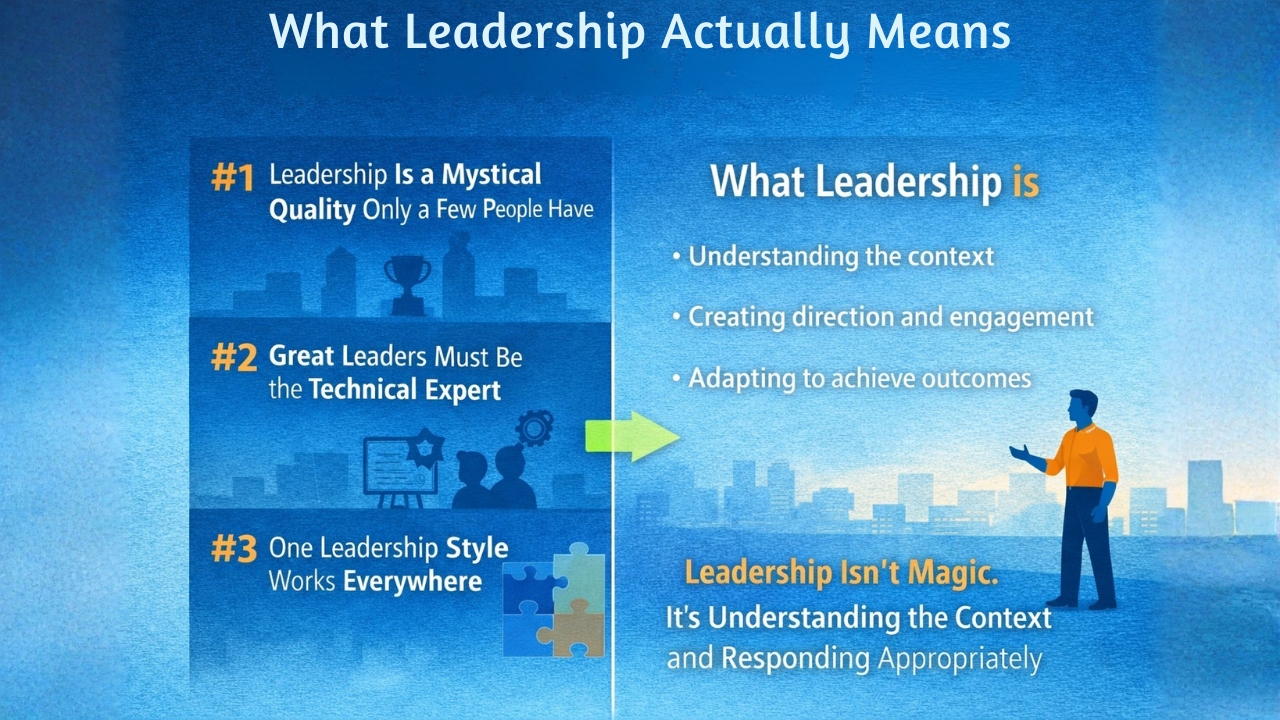
To understand what leadership actually means, leaders first need to let go of three persistent misconceptions.
Misconception #1: Leadership Is a Mystical Quality Only a Few People Have
This is one of the most damaging myths in leadership.
The idea that leaders are “born, not made” creates two problems:
- Some people never step up because they don’t see themselves as “a natural leader”
- Others assume their title or charisma is enough
In reality, leadership isn’t mystical at all.
Leadership is a practical, contextual activity.
It’s about understanding:
- The situation you’re in
- The people you’re leading
- The outcomes required
And then responding appropriately.
That means leadership can be learned, practised, and improved — just like any other capability.
When organisations treat leadership as magic, they stop developing it properly. When they treat it as practical, performance improves.
Misconception #2: Great Leaders Must Be the Technical Expert
This belief is deeply embedded in most organisations. People are promoted because they’re good at the work. They solve problems, fix issues, and know the detail. Over time, that success creates a powerful — but limiting — belief:
“My value as a leader comes from knowing more than others.”
That belief might work in early leadership roles. It fails completely in senior ones.
Leadership is not about:
- Having all the answers
- Being the smartest person in the room
- Solving everyone else’s problems
Leadership is about getting the best out of others. Great leaders create clarity, direction, and space for people to think, contribute, and perform. When leaders stay stuck in “expert mode”, they become bottlenecks instead of multipliers.
Misconception #3: One Leadership Style Works Everywhere
Many leaders are still searching for the leadership style:
- The right model
- The right approach
- The one way to lead
It doesn’t exist. Effective leadership changes with:
- The context
- The capability of the people
- The level of risk
- The challenge being faced
What works in a crisis won’t work in development. What works with a new team won’t work with experienced professionals. What works today may fail tomorrow.
Leadership is not about consistency of style — it’s about consistency of judgement. The best leaders read the situation and adapt how they lead accordingly.
What Leadership Actually Is
Once you strip away the myths, leadership becomes much clearer.
Leadership is:
- Understanding the context
- Creating direction and meaning
- Engaging people in achieving outcomes
- Adapting your approach as conditions change
It’s not magic. It’s not a title. And it’s not about control.
Leadership Is Not a Position — It’s an Identity
One of the biggest shifts leaders need to make is moving away from positional thinking.
Leadership doesn’t come from a job title. It comes from how you show up.
Leadership has to be earned by:
- How you engage with people
- How you respond under pressure
- How you adapt to context
- How you create direction without controlling
The best leaders don’t rely on authority. They create environments where others rise. That’s why leadership is fundamentally an identity, not a role.
Why This Matters Now
In a world of constant change, uncertainty, and pressure, leadership is no longer about command and control.
It’s about:
- Thinking in context
- Leading through influence
- Developing capability, not dependency
- Letting go of outdated beliefs
When leaders cling to old myths, performance stalls. When they adopt a modern, contextual view of leadership, organisations move forward.
Leadership isn’t magic. It’s understanding the context and responding appropriately.
The leaders who thrive today aren’t the loudest, smartest, or most controlling. They’re the ones who let go of outdated beliefs, lead from who they are, and create the conditions for others to succeed.
That’s what leadership actually means.
 Or call Ross directly on 0412 490 250
Call Team Focus Plus on 1300 551 274 or Email team@teamfocusplus.com
Stay Connected
Sign up for our newsletter to get updates on upcoming workshops and transformational leadership programs.