

What happens when technical experts become leaders?
The biggest mistake I see technical experts make when they become leaders isn’t arrogance, and it isn’t the kind of micromanaging people usually picture. It’s something much smaller, much more innocent, and much harder to notice: answering too fast.
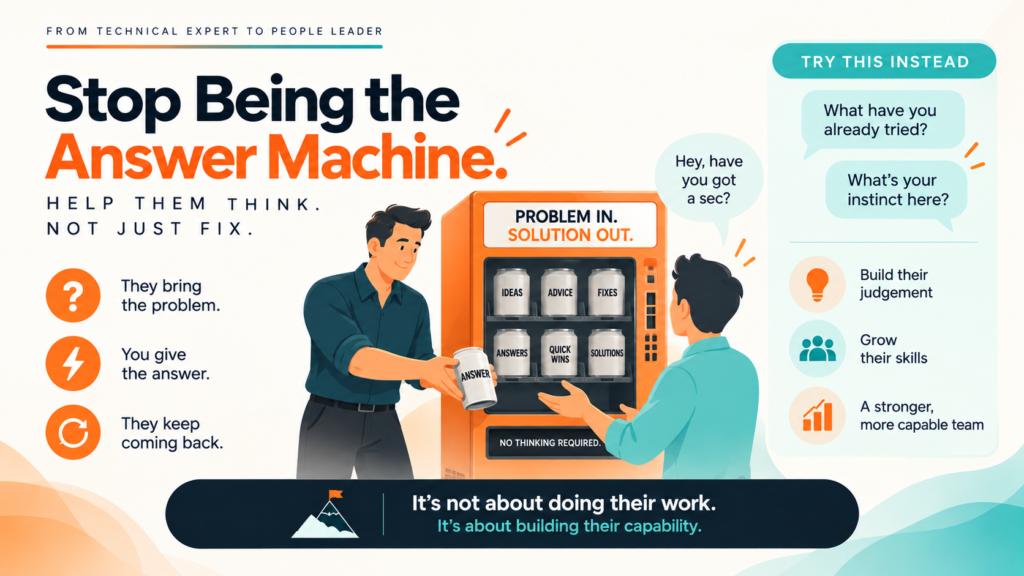
You know the scenario. Someone appears at your desk and says, “Hey, have you got a sec?” Before they’ve even finished explaining, you already have half the answer forming in your head. By the time they’ve laid out the problem, you’re already talking. It feels efficient. It feels helpful. People thank you for it. That’s exactly what makes it so easy to miss.
Here’s what’s actually happening underneath. Every time someone brings you a problem and you hand back a fast, polished answer, you’re training them, without meaning to, that bringing you the problem is faster than working through it themselves.
Think of it like a vending machine. Problem goes in, solution comes out, no thinking required in between. It works brilliantly, right up until your whole team has learned to treat you exactly like a vending machine — insert problem, collect answer, walk away. A vending machine doesn’t build anyone’s judgement. It just gets used, over and over, by people who never had to develop their own.
The cruel part is that this mistake feels like the opposite of a mistake.
You feel useful. You feel needed. Every fast answer is small proof that you’re good at your job. But you’re solving today’s problem while quietly guaranteeing you’ll be asked to solve tomorrow’s identical one too.
I worked with a technical lead a while back who genuinely prided himself on speed. If someone was blocked, he’d have them moving again within minutes, and he told me it was the thing he was proudest of in the role. Then his organisation ran a skip-level survey. His team rated him extremely highly on being helpful and responsive. But on whether their manager was helping them grow their own skills, he scored near the bottom of the department.
He was stunned. He’d been so focused on removing friction for his team that he never noticed he was also removing their reps — the small, slightly uncomfortable moments where people figure something out themselves and quietly get better at their job. Every time he answered fast, he was, in a very real sense, doing their training for them, and then keeping the training.
This week, try resisting the answer for just ten seconds. Ask instead, “What have you already tried?” or “What’s your instinct here?” Notice how often they already had a decent answer, and just wanted permission to trust it.
If this resonates,
the Leader’s Identity Blueprint will help you understand why this habit is so hard to let go of, and what it’s really protecting in you — for a dollar, in about twenty minutes.
 Or call Ross directly on 0412 490 250
Call Team Focus Plus on 1300 551 274 or Email team@teamfocusplus.com
Stay Connected
Sign up for our newsletter to get updates on upcoming workshops and transformational leadership programs.