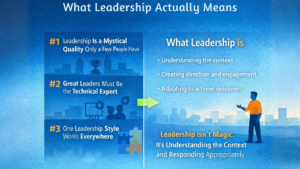
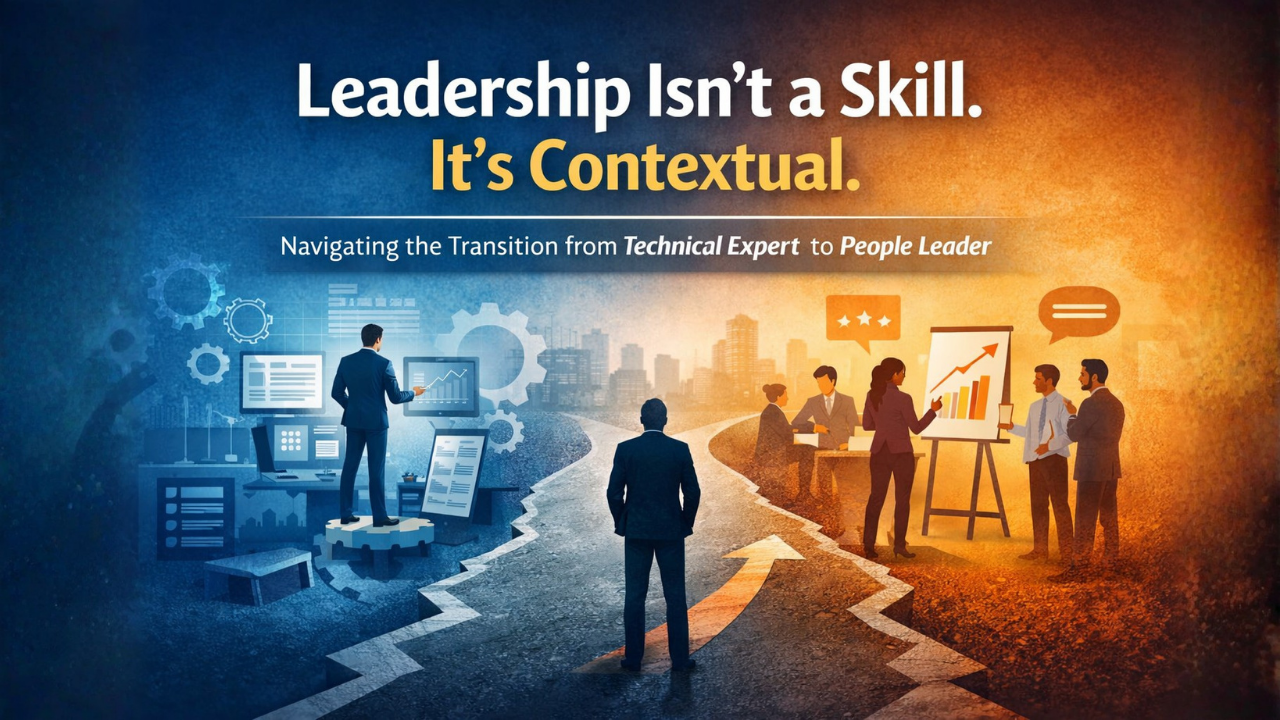
Leadership is Contextual.
What does that mean exactly?
It means your style of leadership, or the way you lead, will need to change as you transition to new leadership roles.
The Myth of Universal Leadership Skills
Leadership is often portrayed as a rare quality, something you either have or don’t, or something you acquire by learning the “right” set of skills. In fact many leadership programs take it a step further and promise transferable skills that work in every situation.
That idea is not only wrong, it’s costly because that type of leadership skill doesn’t exist.
Leadership changes as the context changes. You will need to lead differently the minute there’s a change in:
- The role
- The level of responsibility
- The expectations of others
- The size of the team
- The composition of the team
- The time horizon of decisions
- The complexity of the task
- External factors that are impacting the team
- And so on …
What works in one leadership role can be ineffective, even destructive, in the next.
This is why capable leaders often struggle after being promoted, because what was working in their last role is actually going to hold them back in their new role.
Early Leadership: When Micromanagement Is Appropriate
Here’s a very real example.
In early leadership roles, leadership is largely technical.
People are often promoted because:
- They are strong individual contributors
- They understand the technical work
- They can spot mistakes and solve problems quickly
In this context, leaders are expected to:
- Direct work
- Check quality
- Assign tasks
- Solve technical issues
- And get involved in everything
Micromanagement isn’t a failure here, it’s often the job.
That’s OK in this role, but it will become a problem if the leader doesn’t evolve as they move into the next role.
The Transition
As leaders move into more senior roles, the context changes.
Leadership shifts:
- From technical expertise → to people leadership
- From having the answers → to asking the right questions
- From telling and instructing → to listening and enabling
- From daily problem-solving → to strategic thinking
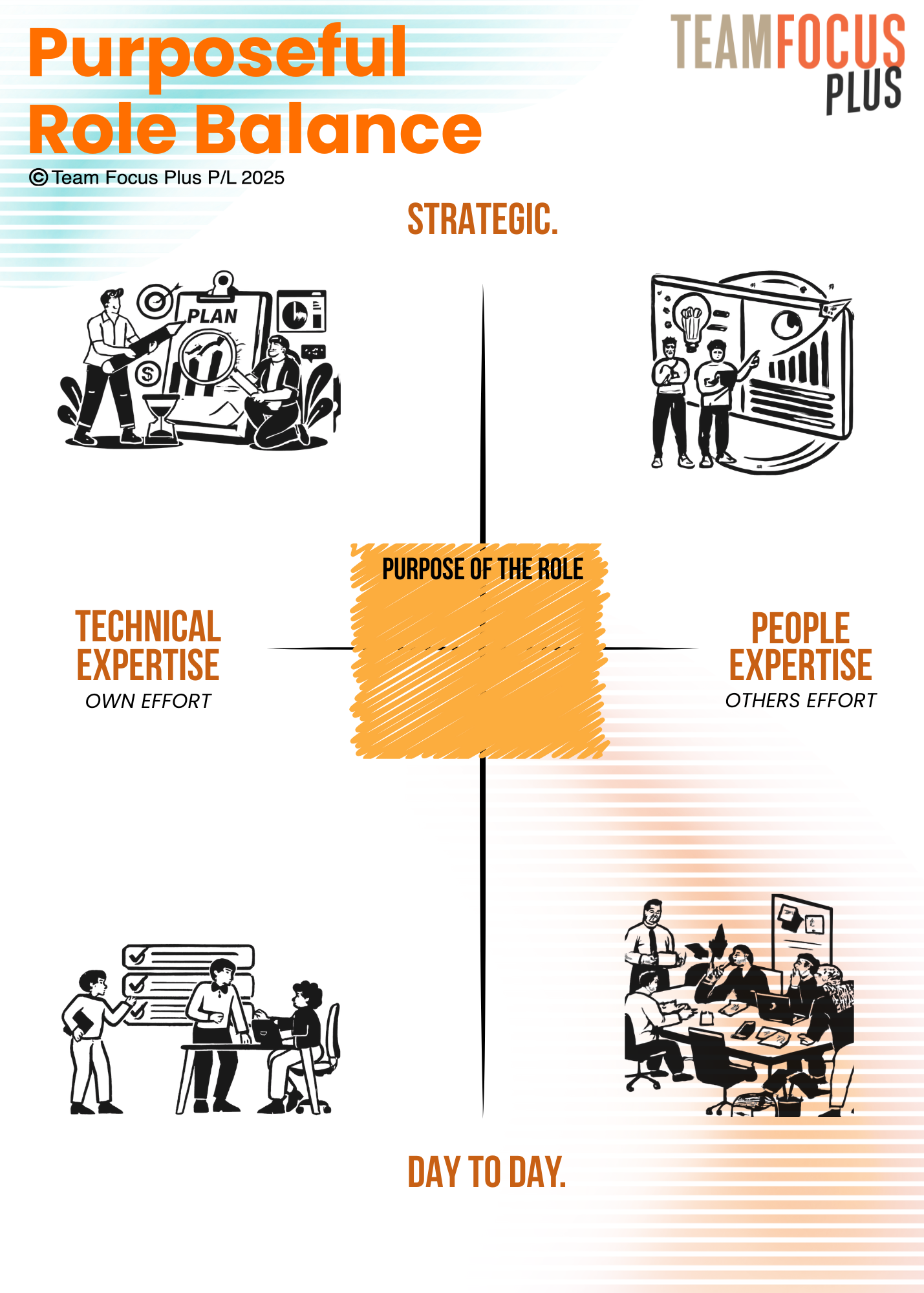
Each transition requires a new balance between:
- Technical vs people leadership
- Day-to-day vs strategic focus
Most leaders are never helped to make this shift. Instead, they’re rewarded for what worked in the past, until it stops working and they are suddenly told they are failing as a leader.
Leadership transitions fail because:
- Expectations are unclear
- Old behaviours are reinforced
- Leaders are left to “figure it out”
- Training focuses on skills, not identity and role
The result is predictable:
- Leaders operate at the wrong level
- Teams become dependent or disengaged
- Performance plateaus
- Culture suffers
This isn’t a motivation problem. It’s a transition problem.
A Simple Framework
One practical way to manage leadership transitions is to consciously review role balance using our Purposeful Role Balance tool. This encourages leaders to regularly ask:
- What are my strategic technical responsibilities in this role?
- What are my strategic people responsibilities?
- What are my day-to-day technical responsibilities?
- What are my day-to-day people responsibilities?
This reflection forces leaders to:
- Think about the balance of technical vs people leadership in their role
- Let go of outdated behaviours and adopt more appropriate behaviours for this role
- Step into new expectations
- Prepare for future roles before they arrive
In short, it helps leaders transition. It’s a simple discipline, but one that most leaders are never taught.
Fast Track Leadership: Accelerating the Transition
This is exactly the gap Fast Track Leadership is designed to address.
Fast Track doesn’t teach generic leadership skills. It focuses on:
- Shifting leaders from technical to people leadership
- Helping them understand how their role has changed
- Re-aligning beliefs, identity, and expectations
- Giving leaders practical models they can apply immediately
It accelerates the transition that most leaders otherwise take years, or never, to make.
The Co-Captain: Sustaining Leadership Capability Through Change
Even when leaders understand the shift, pressure can pull them back into old habits.
That’s where the Co-Captain model comes in.
A Co-Captain works alongside leaders as a trusted partner, focused on:
- Keeping leaders operating at the right level
- Supporting leadership transitions as roles evolve
- Coaching leaders through real-time challenges
- Protecting space for people leadership and strategy
- Preventing regression into micromanagement and firefighting
The Co-Captain doesn’t replace leaders. They enable them to lead at the level their role requires.
Leadership is Contextual
Great leadership isn’t about mastering a mythical set of skills. It’s about:
- Understanding the context you’re leading in
- Letting go of what made you successful in the last role
- Making deliberate transitions as expectations change
Organisations that support these transitions don’t just create better leaders,
they create stronger teams, healthier cultures, and better results.
Instead of asking:
“How do we make our leaders better?”
Ask:
“Are we helping our leaders lead at the right level for the role they’re in now?”
That question changes everything.
 Or call Ross directly on 0412 490 250
Call Team Focus Plus on 1300 551 274 or Email team@teamfocusplus.com
Stay Connected
Sign up for our newsletter to get updates on upcoming workshops and transformational leadership programs.