
Role clarity is one of the most powerful, and underestimated drivers of team performance.
Most leaders recognise the importance of alignment, trust, and accountability. Fewer realise that all three are heavily dependent on one foundational discipline: clear roles.
When roles are unclear, even capable and well-intentioned people struggle to perform at their best. Tension increases, trust erodes, and productivity declines, often without leaders immediately understanding why.
The hidden cost of unclear roles
Many organisations assume role clarity is handled through job descriptions.
Unfortunately, job descriptions are rarely read, rarely updated, and almost always too generic to be useful in day-to-day work.
As a result, teams experience:
- Overlapping responsibilities and duplicated effort
- Important tasks falling through the cracks
- Frustration when people feel others are “doing their job”
- Conflict driven by territory, assumptions, and misaligned expectations
These issues are not behavioural problems. They are leadership problems, and they are completely avoidable.
Why role clarity builds trust (and prevents conflict)
Trust doesn’t break down because people are difficult.
It breaks down when expectations are unclear.
The moment someone believes another person is:
- Overstepping their role
- Making decisions they shouldn’t
- Avoiding responsibility
Trust begins to erode. Conversations become guarded. People protect their territory instead of collaborating. Performance suffers.
Clear roles remove ambiguity. They allow people to work confidently, support each other appropriately, and focus on outcomes instead of politics.
Role clarity is not a one-off conversation
One of the biggest mistakes leaders make is treating role clarity as a static exercise.
Roles evolve. Priorities change. Capability grows. Pressure shifts.
That means role clarity must be reviewed regularly, not set once and forgotten.
High-performing leaders treat role clarity as a continuous leadership discipline — something they actively work on through frequent, structured conversations.
As a minimum, leaders should be revisiting role clarity with their people every few months. In fast-moving environments, it should happen more often.
Why most leaders avoid role clarity conversations
Despite its importance, many leaders avoid these conversations because they don’t have a structure that will help them avoid feeling:
- Awkward or confrontational
- Too complex
- Prone to defensiveness
Without structure, role discussions can quickly drift into complaints, justifications, or micro-detail. But if you try to use the Job Description as the structure it will feel over-engineered and cumbersome. That’s why leaders avoid these conversations.
A structured way to clarify roles without conflict
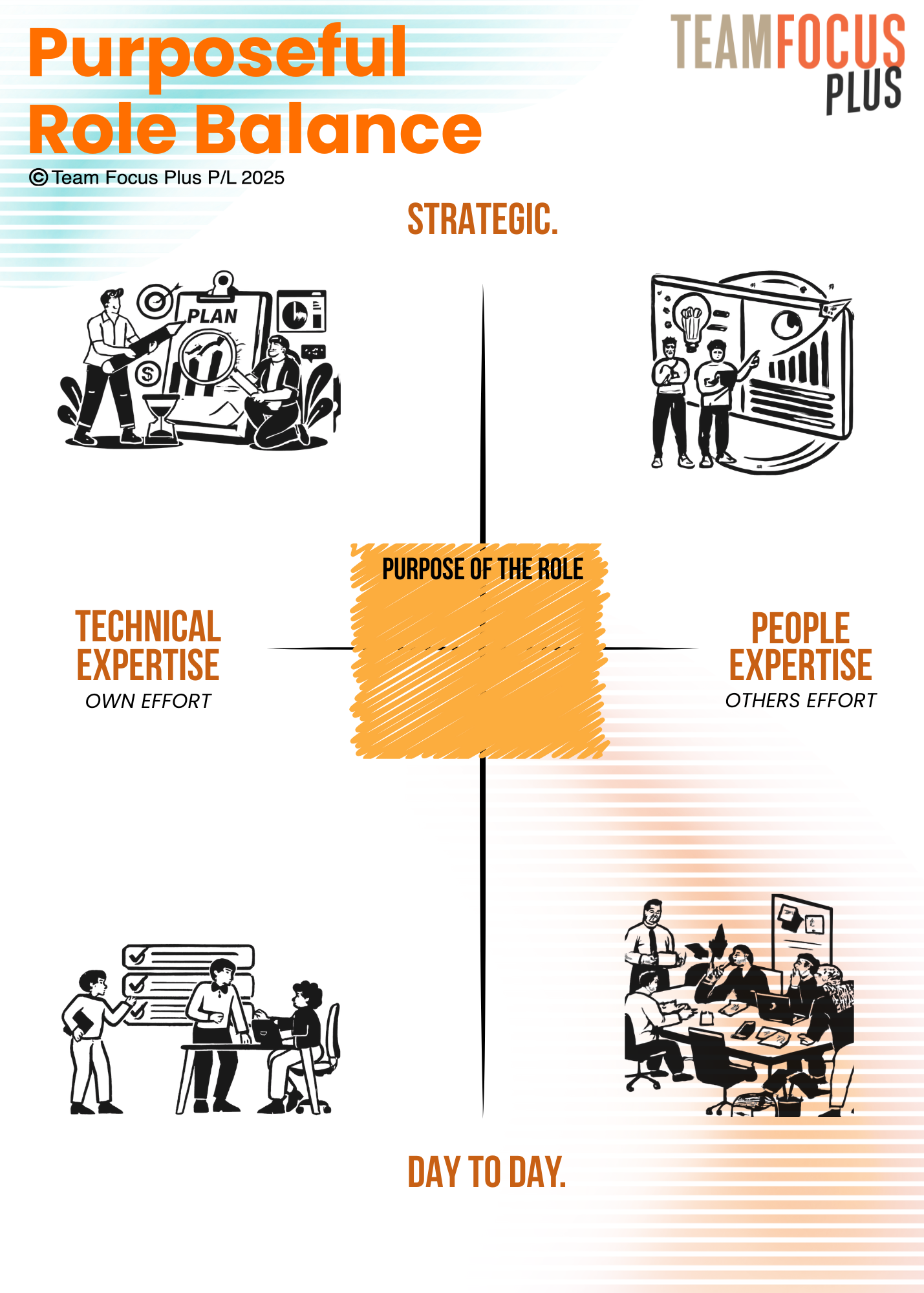
The Leaders Identity Guide includes a wonderful template and tool for these, and other, conversations. The Purposeful Role Balance provides a simple, repeatable structure.
It breaks roles into four distinct areas:
- Strategic technical responsibilities
- Strategic people responsibilities
- Day-to-day technical responsibilities
- Day-to-day people responsibilities
This framework helps you have a conversation that creates clarity without rigidity. It helps leaders and team members:
- Understand what truly matters in the role
- Balance short-term delivery with longer-term contribution
- Align expectations without micromanaging
Most importantly, it keeps conversations constructive and forward-focused.
Developing leaders through role clarity
While the Purposeful Role Balance tool is brilliant for building role clarity, it’s not just about task allocation.
It’s also one of the most effective ways to:
- Develop leadership capability
- Support people stepping into bigger roles
- Clarify decision-making authority
- Improve accountability without pressure
When people understand the full scope of their role, especially the people and leadership aspects, they perform with greater confidence and ownership.
Role clarity as a leadership responsibility
If leaders don’t actively create role clarity, confusion will fill the gap.
And confusion leads to:
- Stress
- Conflict
- Reduced engagement
- Underperformance
Role clarity is not an HR task. It’s a core leadership responsibility, and one of the simplest ways to improve trust, alignment, and results across a team.
Leaders who invest time in clarifying roles consistently find they spend less time resolving conflict, less time firefighting, and more time leading.
 Or call Ross directly on 0412 490 250
Call Team Focus Plus on 1300 551 274 or Email team@teamfocusplus.com
Stay Connected
Sign up for our newsletter to get updates on upcoming workshops and transformational leadership programs.